Parlor Songs of Pittsburgh: "The Wreck of the Flyer Duquesne"
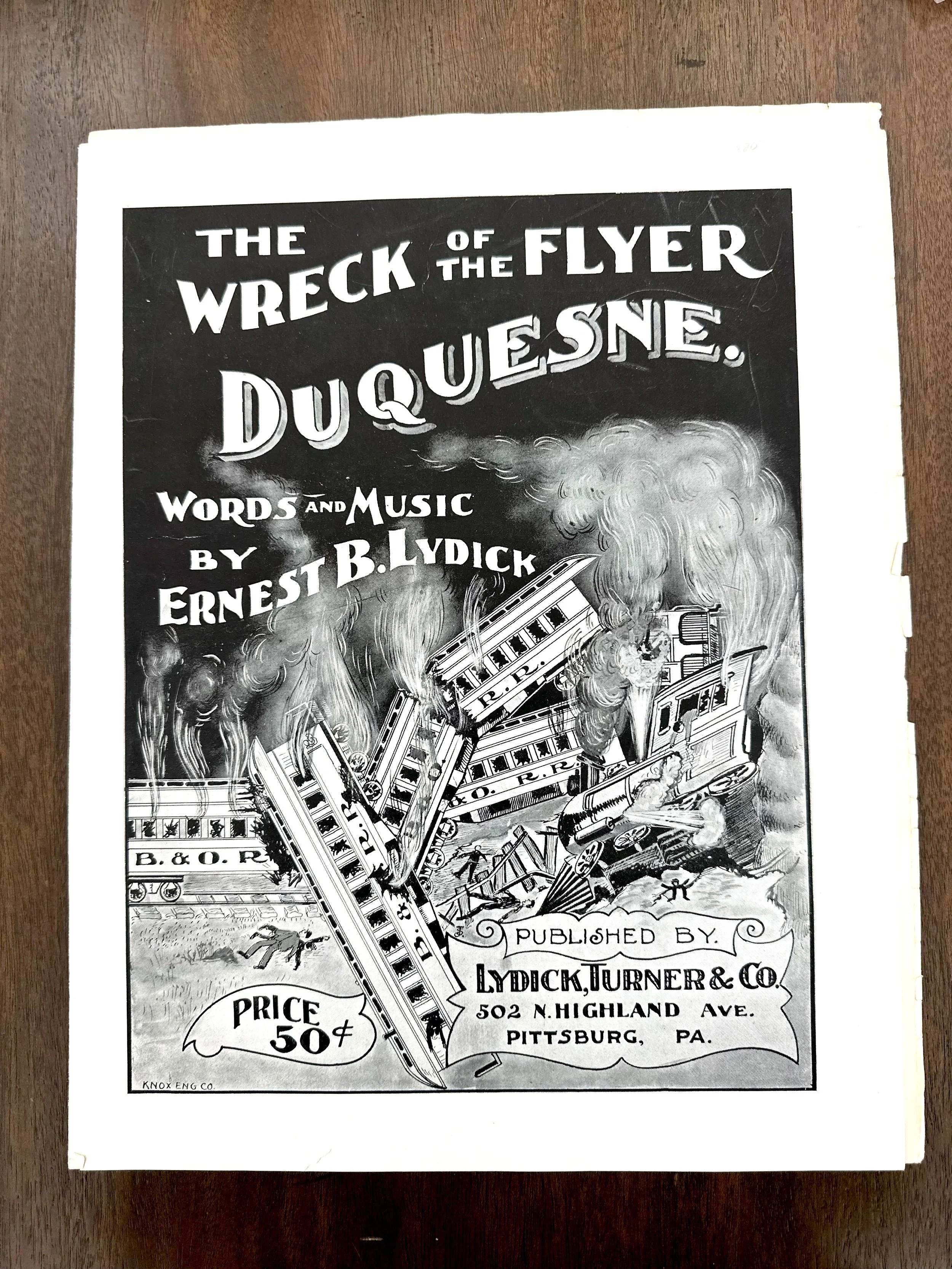
On the evening of December 23rd, 1903, just two days before Christmas, a passenger train, making route from Pittsburg to Philadelphia and then New York, went off the rails on a sharp bend in Laurel Run just seven miles out of Connellsville, a booming industrial town at this time. Railroad ties were lying across the tracks, because a freight train had lost its load. In an effort to keep his schedule, the engineer was speeding around the bend at a rate of 60 miles per hour. While this wasn’t an ungodly speed for the train, it certainly would never have been slow enough to spot the obstruction and slow before colliding. One should note that keeping a train to its schedule, before the time of instant correspondence, was another measure of safety. That measure did not yield safety in this case. When the train collided with the lost load, it derailed, and forty three passengers died instantly. The death total eventually reached seventy casualties. Most gruesomely, the smoking car was punctured by the steam dome, killing everyone inside of it.
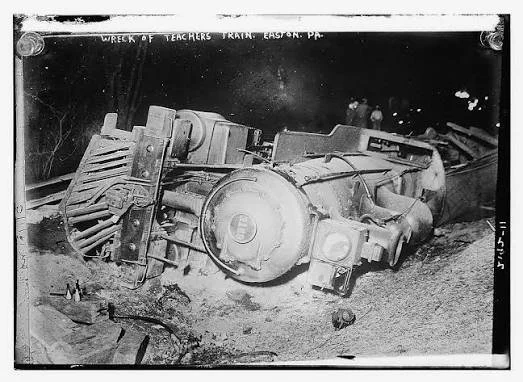
The Wreck of the Duquesne Limited, December 23rd, 1903
The death toll was shocking, even for this time in history, when railroad accidents were far more common. Although Connellsville had been experiencing an economic boom at the time, the town was still hard pressed to provide sufficient aid. The Courier reported that the deceased were taken to City Hall, where prisoners were released from confinement to make room. They also had to call on morticians from neighboring towns (1).
Several human interest stories from the tragedy captivated the hearts of newspaper readers. Notably, an obituary on a Mr. Good traveling from his home in McKeesport to Pittsburg onto to New York City to meet his fiancé peaked the romantic curiousity of many. Mr. Good’s fiancée arrived on Ellis Island on Christmas Day to learn the news. Mr. Good was not only traveling to meet her, but The Courier reported that the betrothed were intended to marry as soon just a few days following the accident. Mr. Good’s brothers came to identify him in Connellsville.
A somewhat fictionalized, embellished version of events exist, immortalized by Ernest B. Lydick in his parlor song, “The Wreck of the Flyer Duquesne.” Lydick’s version of events include an ancillary tale wherein Mr. Good’s fiancée is already awaiting him in New York. She learns of the wreck from the papers, but is somehow still able to arrive aboard a “special train charter” that brought her to the scene of the wreck wherein she reunites with him briefly before his dying breath. This version of events is nowhere recounted in local newspapers.
The song is heart rending and dramatic. It leaves you wishing, that this version of events could have occurred if there had to be such a tragedy. It is not clear what happened to Mr. Good’s fiancée. We do not know her name. We do not know how long it took her to be fully processed as an immigrant or even whether she stayed. We do know that she was coming from England. The lyrics for the tune are written below.
The heart of a maiden was beating with pleasure
as the day of her wedding drew near
She sang as she placed holy wreaths in the window
“Tomorrow my love will be here.”
The message he sent me brought joy to my heart
but seems to be haunting my brain.
“If I am alive, my dear, I’ll arrive on the limited Flyer Duquesne.”
On the Limited Flyer Duquesne
like a dart it speeds over the plain.
May the angels above watch over my love
on the limited flyer Duquesne.
While tying one wreath with a bow of red ribbon,
she saw a commotion outside.
It seemed all the newsboys were running with papers
“An awful disaster!” they cried.
She listened intently to hear something more.
She heard, but the hearing brought pain.
One newsie ran by and loudly did cry,
the wreck of the flyer Duquesne.
The wreck of the flyer Duquesne
My God! and my love on that train
Not a moment I’ll wait, I must know the fate
of my love on the flyer Duquesne.
A special train chartered, was quickly conveying,
her nearer that heart-rending scene.
Where death and destruction had wrought awful havoc
and corpses were strewn o’er the green.
Arrived at the place soon her lover she found
her coming had not been in vain.
On a cot he was lying, well not dead, but dying
near the wreck of the flyer Duquesne
Near the wreck of the flyer Duquesne
she was clasped to his bosom again
but she ne’er was his bride,
for her lover there died
near the wreck of the flyer Duquesne.
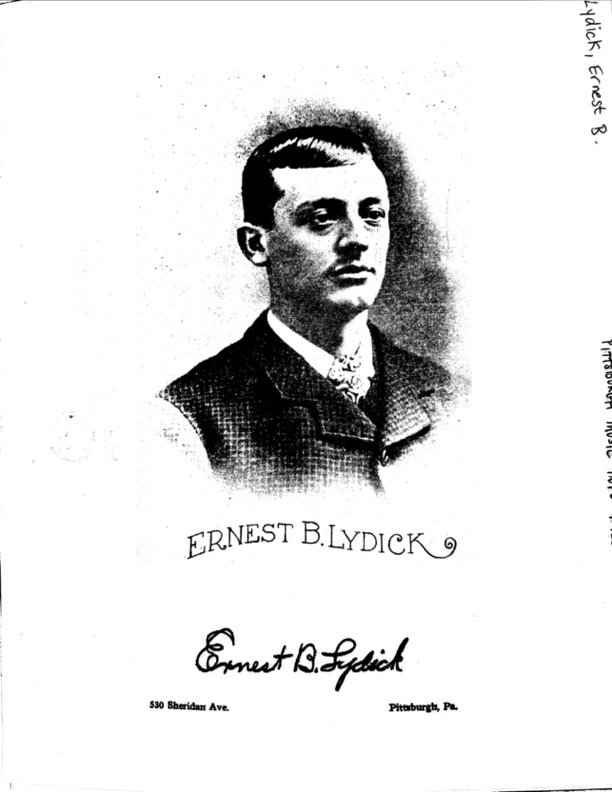
The composer who ensured that the Good love story and its tragic ending live on, is another matter. Ernest Broadway Lydick was larger than life in many ways. Born in Indiana, Pennsylvania in 1862, he was known amongst the townsfolk for the mouse circus he hosted in the family barn. A mouse circus is quite literally what it sounds like… The last circus show ended with a mouse being ejected from a toy cannon into the lap of a lady in the front row, much to her chagrin. Shortly after, in 1900, Lydick moved to Pittsburgh in order to sell his inventions which included a potato cutter and coconut grinder. Finding little success in the field of invention and sales, he pivoted to become a streetcar motorman for Pittsburgh Railway Co. (2)
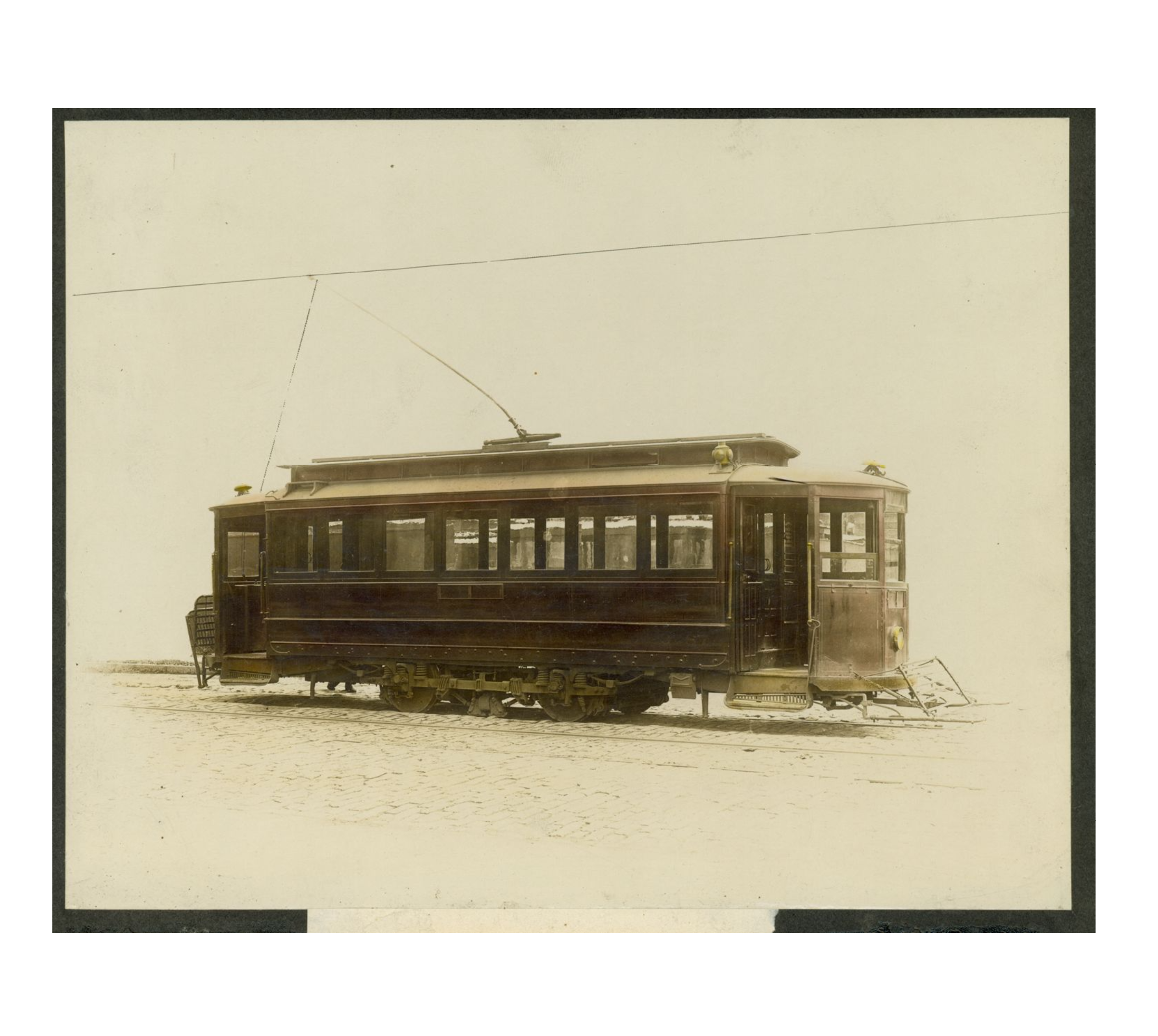
The streetcar that was in general use in 1900 across the city. It had open platforms at the front and rear of the car.
Pittsburgh Railways Company Records, 1872-1974, AIS.1974.29, Archives & Special Collections, University of Pittsburgh Library System.
He also began composing parlor song and publishing the music himself. Today, we might call Lydick’s music career a “side hustle.” Back then, however, they didn’t have any fancy way of categorizing their income streams. Evidently, Lydick was a multi-passionate individual that couldn’t help but create. Lydick didn’t achieve much celebrity beyond his lifetime other than some newspaper articles and locals enjoying his music. However, his music still has a firm place in the Pittsburgh Sheet Music Collection thanks to donations and careful work of librarians working to preserve these jewels.
Instead of a celebrity, Lydick was an artist’s artist. His work often showcased stunning hand drawn iconography or a local vaudeville singer, who was hailed for singing the tune. The subjects of his work often had a common touch. A human interest story (“The Wreck of the Flyer Duquesne”), an ode to a local bar (as in “The Rinkey Doo Cafe”), or a lover’s scandal (“If the Benches in the Park Could Tell”). Lydick published out of his home in East Liberty, and it seems nothing stopped him from being an artist—surely not public opinion, nor pearl clutching, nor working long hours as a motorman.
Please enjoy this snippet of “The Wreck of the Flyer Duquesne.” A full recording will follow soon as will many other Lydick tunes.
If you would like to learn more about Ernest B. Lydick, please consider attending my upcoming lecture with East Liberty Valley Historical Society on Wednesday December 2nd at 7pm. I will be singing more of his music LIVE(!) as well. Lecture Recital will be held at Parish Hall of Calvary Episcopal Church, 315 Shady Ave., 15206. (Use Marchand Street entrance.) Free parking in church lot.
The Courier, Connellsville, PA, Thursday Evening, December 24, 1903, page 1, columns 1-4
The Pittsburgh Press, Pittsburgh, PA, Sunday, February 17, 1957, page 4.
Special thanks to Carnegie Library of Pittsburgh & Joelle Killebrew, music librarian, for her tireless work to preserve our region’s rich musical heritage. Her archival work with the Pittsburgh Sheet Music Collection and Binder Collections, as well as her expertise and guidance has made my Pittsburgh Parlor Song Project possible.